H-MTD Z-Coded Automotive Ethernet High-Speed Data Cable: Features, Applications and Selection Guide
In-depth exploration of the H-MTD Z-coded female-to-female in-vehicle high-speed data cable, featuring 100Ω differential impedance, DC–10GHz frequency range, and up to 10Gbps transmission speed, suitable for ADAS, 4K displays, domain controllers, in-vehicle gateways, and high-speed automotive networks.
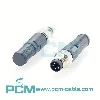
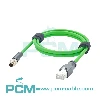
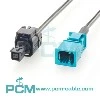
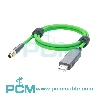
PCM-ZC-0017-X is an H-MTD Z-coded female-to-female automotive high-speed data cable using Rosenberger E6K10A-1CAZ5-Z connectors and GG 2Speed 251 cable, with 100Ω impedance, DC–10GHz bandwidth and up to 10Gbps for ADAS and vehicle networks.
Quick Product Introduction
Standard Structure PCM-ZC-0017-X:
Rosenberger H-MTD Z-Coded Jack
E6K10A-1CAZ5-Z
↓
GG 2Speed 251
Shielded Differential High-Speed Cable
↓
Rosenberger H-MTD Z-Coded Jack
E6K10A-1CAZ5-Z
| Product Name | H-MTD Automotive Ethernet High-Speed Data Cable |
| Connector A | H-MTD connector, female, Rosenberger E6K10A-1CAZ5-Z, Z code |
| Connector B | H-MTD connector, female, Rosenberger E6K10A-1CAZ5-Z, Z code |
| Premier Cable P/N | PCM-ZC-0017 |
| Connector Type | H-MTD Straight Jack |
| Coding | ZCoding |
| Cable | GG 2Speed 251 |
| Length | 0.5 / 1 / 2 / 3 / 5m |

What Is H-MTD ?
H-MTD stands for High-Speed Modular Twisted-Pair Data, a high-speed differential data interconnect system developed by Rosenberger. It is designed to address the demands of modern vehicles for high bandwidth, compact packaging, and reliable connectivity.
Its modular architecture and multiple coding options provide flexibility for automotive Ethernet, vehicle cameras, ADAS, display systems, infotainment, and central computing applications.
H-MTD is a physical interconnect platform rather than a specific communication protocol; actual data rates and protocol compatibility depend on the complete cable assembly and equipment link.
PCM-ZC-0017 →Why Is H-MTD Suitable for Vehicles ?
Automotive high-speed connectors must support data transmission while addressing limited installation space, continuous vibration, cable strain, dense connector layouts, complex EMI, temperature variations, and assembly error prevention.
H-MTD addresses these requirements through compact connector designs, mechanical coding, locking mechanisms, differential transmission, and shielded cable construction.
These features improve routing flexibility and connection reliability, help reduce incorrect mating and accidental disconnection, and support electromagnetic interference control. Actual performance must still be validated against the cable assembly, installation environment, and complete signal link.

Pain point analysis
Core Product Value

PCM-ZC-0017
The core advantages of PCM-ZC-0017 can be summarized as:
◆ Up to 10Gbps High-Speed Data
PCM-ZC-0017-X is designed for high-speed links targeting up to 10Gbps, supporting bandwidth-intensive ADAS, high-resolution automotive video, sensor data exchange, and central computing applications. Actual data rates depend on the equipment PHY, protocol, cable length, and complete link validation.
◆ 100Ω Impedance and DC–10GHz BandwidthCAT6A The 100Ω differential impedance and DC–10GHz frequency design provide a controlled transmission path for high-speed digital signals, helping reduce impedance discontinuities and reflections. Actual link margin should be evaluated through insertion loss, return loss, and system-level signal integrity testing.
◆ Rosenberger H-MTD Z-Coded Connectors
Both ends feature Rosenberger E6K10A-1CAZ5-Z H-MTD straight jacks. Z-coding provides mechanical keying, while the locking structure helps maintain connection stability in automotive vibration environments. Mating connector compatibility, coding, pin assignment, and equipment port requirements must be verified before installation.
◆ Flexible Vehicle Harness Lengths
Available in 0.5m, 1m, 2m, 3m, and 5m lengths, the cable allows engineers to select suitable routing distances between cameras, domain controllers, switches, displays, and central computing platforms. Proper length selection reduces excess cable while accommodating bend radius, mounting, and signal integrity requirements.

Products Display

Similar products

Compatibility Statement
Compatibility Verification
Mechanical mating of H-MTD connectors does not guarantee electrical or protocol compatibility. Before selection, verify the connector part number, coding, gender, pin assignment, differential impedance, PHY, protocol, data rate, and cable length.
Insertion loss, return loss, and the equipment manufacturer's channel budget must also be confirmed. H-MTD is a high-speed differential physical interconnect platform, so matching connector geometry alone is insufficient to establish system compatibility.
Technical Compatibility Notice
H-MTD can support compatible automotive Ethernet and high-speed SerDes links, including various BASE-T1 data rates, GMSL, FPD-Link, and other applications, but the connector itself does not define a specific protocol.
The maximum 20GHz and 56Gbps capabilities of the broader Rosenberger H-MTD family must not be applied automatically to an individual cable assembly.
PCM-ZC-0017-X should be specified as DC–10GHz and up to 10Gbps, with actual performance verified through equipment compatibility, cable length, and complete link testing.
H-MTD ≠ A Specific Protocol
Family-Level Performance ≠ Product-Specific Performance
How to Choose an H-MTD Cable ?
Verify Coding and Connector Part Number
Verify the exact H-MTD coding, connector gender and part number rather than selecting by connector appearance alone.
Verify Protocol, PHY and Data Rate
Confirm the actual Ethernet or SerDes protocol and PHY requirements because the H-MTD cable performs no protocol conversion.
Select Length from the Link Budget
Select cable length according to insertion loss, return loss and the complete high-speed channel budget.
Verify Environmental Requirements
Verify temperature, vibration, EMC, bend radius and OEM qualification requirements for the intended vehicle installation.
Customization Capabilities
↕ H-MTD Coding and Connector Customization
H-MTD coding, jack/plug gender and connector combinations can be customized.
□ Custom Cable Lengths
Custom lengths can be developed according to vehicle routing and link-budget requirements.
◉ High-Speed Cable Customization
High-speed twisted-pair cable constructions can be selected according to bandwidth, flexibility and EMC requirements.
⚙ Shielding and EMC Customization
Shielding and 360-degree termination structures can be optimized for vehicle EMC requirements.
⌘ Labeling and Assembly Customization
Cable labels, endpoint identification, protective caps and packaging can be customized for vehicle assembly.
◇ OEM/ODM Automotive High-Speed Harness Development
OEM/ODM H-MTD assemblies can be developed according to connector, PHY, protocol, frequency and complete high-speed channel requirements.
Conclusion:
PCM-ZC-0017-X uses an H-MTD Z-coded jack-to-jack interface architecture similar to Rosenberger LCA-101-1000-Z-Z and can be evaluated as an alternative for compatible automotive high-speed data applications. Verify cable construction, length, pinout and complete channel performance before replacement.
Product FAQ
What Is the PCM-ZC-0017-X Configuration ?
It uses Rosenberger E6K10A-1CAZ5-Z H-MTD Z-coded jacks on both ends with GG 2Speed 251 cable.
Does the Temperature Range Mean Automotive Certification ?
No. Temperature capability alone does not establish full automotive qualification.
How Do I Verify Compatibility ?
Provide the exact connector, coding, pinout, PHY, protocol, data rate, cable length and channel requirements for full mechanical and high-speed electrical validation.
Why Does Cable Length Matter ?
Longer cables generally increase attenuation and reduce available signal-integrity margin.
Why Is Connector Locking Important ?
Mechanical locking improves connection security in vibrating vehicle environments, while CPA is an optional feature on specific H-MTD versions.
Why Use Differential Transmission ?
Differential signaling improves noise immunity and signal integrity for high-speed automotive data links.