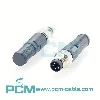
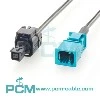
H-MTD to MATEnet Automotive Ethernet Cable: Features, Applications and Selection Guide
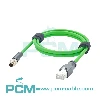
1000 H-MTD to MATEnet automotive Ethernet cable with DACAR 647-4STP and Z-coded connectors for ADAS, cameras, ECUs and gateway.
PCM-ZC-0021 is a 1m H-MTD Z-coded to MATEnet Z-coded automotive Ethernet cable using 100Ω LEONI DACAR 647-4 STP. It supports shielded differential data links for ADAS, cameras, ECUs, gateways and in-vehicle network systems in modern autos.
Modern vehicle architectures increasingly combine high-speed cameras, ADAS sensors, gateways, domain controllers and central computers from different suppliers.
PCM-ZC-0021 provides a passive 100Ω shielded differential interconnect between compatible Rosenberger H-MTD and TE Connectivity MATEnet interfaces.
Quick Product Introduction
PCM-ZC-0021 Standard Structure:
Rosenberger H-MTDE6K10A-1BZZ5-Z
Z-Coded Jack
↓
LEONI DACAR 647-4Shielded Twisted Pair
↓
TE Connectivity MATEnet 2302510-9
Z-Coded Female-Terminal Housing
| Product Name | H-MTD to MATEnet Automotive Ethernet Cable |
| Premier Cable P/N | PCM-ZC-0021 |
| Connector A | Rosenberger H-MTD E6K10A-1RZZ5-Z |
| Connector B | TE MATEnet 2302510-9 |
| Cable | LEON DACAR 647-4 |
| Length | 1000±15mm |
| Operating Temperature | -40°C to +105°C |
| Differential Impedance | 100Ω |
PCM-ZC-0021 H-MTD-MATEnet vs H-MTD-H-MTD
| Comparison | PCM-ZC-0021 H-MTD-MATEnet | H-MTD-H-MTD |
|---|---|---|
| Inter-Series Connection | Yes | No |
| 100Q Differential Link | Yes | Yes |
| Cross-Supplier Integration | Excellent | Limited |
| ST Cable | Yes | Depends |

What Is an H-MTD-to-MATEnet Automotive Ethernet Cable ?
An H-MTD-to-MATEnet cable is an inter-series high-speed differential passive cable assembly. It connects an H-MTD interface to a MATEnet interface through a 100Ω shielded twisted pair, establishing a physical electrical connection between compatible automotive devices.
The assembly supports connector-format adaptation, high-speed signal pass-through, cable extension, and interconnection across different connector platforms for vehicle ECUs, sensors, gateways, and controllers.
It contains no PHY, switch, media converter, or protocol conversion circuitry. Actual communication capability depends on the connected equipment and complete channel compatibility.
PCM-ZC-0021 →What Is MATEnet ?
MATEnet is a modular, miniaturized high-speed data connector system developed by TE Connectivity for Automotive Ethernet applications. Its compact, scalable, automotive-grade design supports both unshielded twisted-pair (UTP) and shielded twisted-pair (STP) cable configurations.
Standard MATEnet systems can be used in compatible 100BASE-T1 and 1000BASE-T1 links, serving rear-view cameras, vehicle networking, LiDAR, radar, multimedia, and on-board diagnostics.
Actual data rates, shielding configurations, and electrical performance must be verified against the specific connector specifications and complete communication channel.

Pain point analysis
Core Product Value

PCM-ZC-0021
The core advantages of PCM-ZC-0021 can be summarized as:
◆ H-MTD to MATEnet Inter Series Connectivity
The cable combines a Rosenberger H-MTD connector with a TE Connectivity MATEnet connector, enabling direct high-speed differential interconnection between compatible connector platforms. It reduces additional mechanical adapters and connection stages, making it suitable for automotive ECUs, sensors, gateways, and controllers. Actual compatibility must be verified against the coding, pin assignment, and protocol requirements of both connected devices.
◆ Controlled 100Ω Differential PathThe nominal 100Ω differential impedance, combined with LEONI DACAR 647-4 automotive Ethernet cable, provides a controlled transmission foundation for compatible 100BASE-T1, 1000BASE-T1, and other high-speed differential links. Proper impedance control helps reduce reflections and signal integrity risks. Actual data rates and link margin must still be verified through insertion loss, return loss, and complete channel budget evaluation.
◆ LEONI DACAR 647-4 STP
LEONI DACAR 647-4 provides a shielded automotive twisted-pair architecture designed for high-speed vehicle data transmission. Its differential pair construction and shielding system help control external electromagnetic interference in automotive wiring environments. Shielding effectiveness and temperature suitability depend on the exact cable specification, termination method, grounding design, and validation of the complete cable assembly.
◆ Z Coding and Secure Mechanical Connection
The H-MTD and MATEnet ends use Z-coding within their respective connector families, together with automotive locking structures to support correct assembly and secure mating under vibration. Z-coding on both ends does not mean the connectors are interchangeable or share identical pinouts. Exact mating part numbers, mechanical dimensions, and locking compatibility must be confirmed before installation.

Products Display

Similar products

Compatibility Statement
Compatibility Verification
PCM-ZC-0021 combines H-MTD and MATEnet interfaces, but mechanical mating does not guarantee electrical or protocol compatibility. Before selection, verify connector part numbers, coding, gender, pin assignment, PHY, protocol, data rate, differential impedance, and cable length.
Insertion loss, return loss, shield termination, and the equipment manufacturer's channel budget must also be confirmed. Z Coding belongs to each connector family's mechanical keying system and does not establish identical pinouts or electrical performance.
H-MTD Z Coding ≠ MATEnet Z Coding
Technical Compatibility Notice
H-MTD and MATEnet are distinct high-speed automotive data connector platforms with different technical architectures and product capabilities. The higher-frequency and higher-data-rate capabilities of the broader H-MTD family cannot be applied automatically to an H-MTD-to-MATEnet assembly.
PCM-ZC-0021's DC–10GHz specification describes its target frequency-domain performance, not a guaranteed 10Gbps Ethernet data rate. Actual throughput depends on the complete channel, including the MATEnet interface, PHY, cable, termination, and connected equipment, and must be verified through system-level testing.
DC–10GHz Frequency Range ≠ Guaranteed 10Gbps Ethernet Data Rate
How to Choose the Correct Cable ?
Verify Exact Connector Part Numbers and Coding
Always verify the exact Rosenberger and TE connector part numbers, gender and coding rather than selecting by product-family name alone.
Verify Protocol, PHY and Pinout
Verify the PHY, protocol and pin assignment because the cable performs no active signal or protocol conversion.
Verify Data Rate and Channel Budget
Determine the supported data rate from the full channel budget rather than from frequency or impedance specifications alone.
Verify Automotive Environmental Requirements
Verify temperature, vibration, shielding, bend radius and sealing requirements. TE lists 2302510-9 itself as non-sealable.
Customization Capabilities
↕ H-MTD Connector Customization
H-MTD gender, coding and connector part numbers can be customized according to the target ECU interface.
□ MATEnet Connector Customization
MATEnet frame, terminal gender, coding and interface configurations can be customized.
◉ Pin Assignment Customization
H-MTD-to-MATEnet pin mapping can be customized according to customer wiring diagrams and PHY requirements.
⚙ Cable Length Customization
Custom cable lengths can be produced according to vehicle routing and channel-budget requirements.
⌘ High-Speed Cable and Shielding Customization
Alternative automotive Ethernet cable and shielding constructions can be developed according to EMC and signal-integrity requirements.
◇ OEM/ODM High-Speed Harness Development
Complete OEM/ODM H-MTD-to-MATEnet assemblies can be developed with customized mechanical, electrical and high-speed validation requirements.
Product FAQ
Are H-MTD and MATEnet the Same Connector ?
No. H-MTD and MATEnet are separate automotive connector systems and cannot mate directly with each other.
Why Use Shielded Twisted Pair ?
STP combines differential twisted-pair transmission with shielding to improve immunity to electromagnetic interference.
What Is Differential Signaling ?
Differential signaling transmits information through the voltage difference between two matched conductors.
Is H-MTD Only for Ethernet ?
No. H-MTD is a physical high-speed connector platform capable of supporting multiple Ethernet and SerDes technologies.
Is H-MTD Z Coding the Same as MATEnet Z Coding ?
No. Z coding is defined independently within each connector family and does not make H-MTD and MATEnet mechanically interchangeable.
Why Use a 1m Cable ?
A 1m length provides practical routing between nearby automotive high-speed nodes while minimizing excess cable.