If you’re an engineer, system integrator, or anyone who relies on Gigabit Ethernet (GigE) cables for industrial or machine vision applications, you’ve likely heard the term “return loss” thrown around in technical specs—and if you haven’t, it’s one of the most critical metrics to understand for reliable performance. As a GigE cable supplier that works with customers building everything from assembly line inspection systems to high-speed industrial camera setups, I’ve spent thousands of hours explaining return loss in plain language (and troubleshooting when it’s not up to par) so teams don’t face frustrating signal issues down the line. Let’s break down what return loss actually means for GigE cables, why it matters, and how our range of custom-engineered GigE cables is built to deliver industry-leading return loss performance.
First, let’s start with the basics of how GigE data travels. Gigabit Ethernet transmits data at 1 Gigabit per second over twisted-pair copper cables, using four of the eight conductors in the RJ45 connector to send and receive signals. Think of a signal traveling down a GigE cable like a sound wave moving through a pipe: if the pipe is a consistent, unobstructed diameter, nearly all the wave reaches its destination. But if there’s a kink, a narrow spot, or a gap in the pipe, some of that sound bounces back instead of continuing forward. That bouncing sound is exactly what return loss is for Ethernet cables: it’s the measure of how much of the electrical signal is reflected back from the far end of the cable, rather than being transmitted to the connected device.
Return loss is quantified in decibels (dB), and unlike some metrics where higher numbers can be confusing, here higher dB values are better. A higher return loss means less signal reflection, which translates to fewer errors, more consistent data transfer, and less dropped packets—non-negotiable for GigE, where even a single lost packet can disrupt a machine vision inspection or slow down a production line. The key frequency range for GigE is between 100 MHz and 1.2 GHz, which is where return loss is tested for Cat 5e, Cat 6, and Cat 6a GigE cables; for reference, Cat 5e is the minimum spec for 1 Gbps, but most industrial GigE cables use Cat 6 or higher for better performance.
So why does return loss matter specifically for GigE, and especially for industrial applications? Unlike office networks where a dropped packet might just mean a delayed email, industrial GigE systems power everything from robotic pick-and-place arms to high-resolution cameras that inspect food packaging for defects 24/7. If your cable has poor return loss, you’ll start seeing signal attenuation (signal loss over distance), high bit error rates (BER), and even complete data dropout during critical operations. I’ve had customers come to us after buying generic off-the-shelf GigE cables that worked fine for a few weeks, then started causing intermittent errors when they moved to a higher-speed camera or longer cable runs. Almost every time, the culprit was poor return loss from low-quality manufacturing, inconsistent conductor spacing, or flimsy connectors that didn’t maintain proper impedance.
Impedance is the hidden foundation of return loss here. All GigE cables are designed to have a characteristic impedance of 100 ohms. If any part of the cable or connector deviates from that 100-ohm target—whether that’s uneven insulation thickness in the twisted pairs, a poorly crimped RJ45 pin, or a connector that doesn’t lock tightly (leading to a gap between the cable and device port)—you get signal reflection, aka low return loss. For industrial applications, this is even more critical because cables are often routed through tight spaces, bent around machinery, or pulled on during installation, all of which can nudge impedance off-target if the cable isn’t built to withstand those stresses.
Let’s get into the real-world numbers, because specs mean nothing without context. For a Cat 6 GigE cable operating at 500 MHz (a common middle range for GigE), the TIA (Telecommunications Industry Association) sets a minimum return loss requirement of 20 dB. That means at least 99% of the signal is transmitted, with only 1% reflected back. For Cat 6a cables, which support faster GigE variants up to 10 Gbps, the minimum jumps to 25 dB at the same frequency, to account for the higher data density. But our industrial GigE cables—engineered specifically for machine vision and harsh environments—exceed these minimums, often hitting 28-32 dB return loss across the entire GigE frequency band. That extra margin isn’t just a number on a spec sheet; it’s insurance against the wear and tear of industrial use.
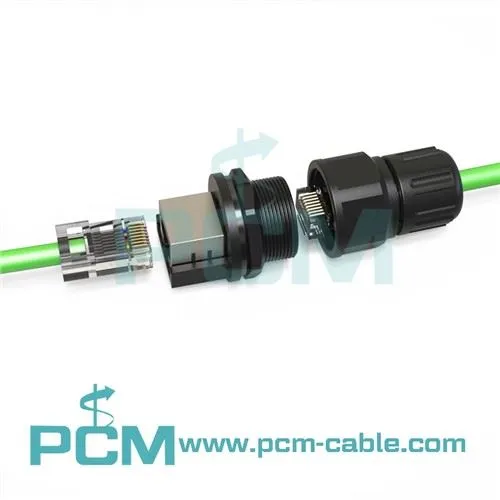
Now, how do we design our cables to hit those high return loss numbers? It starts with the materials. We use solid-core copper conductors (not the cheaper stranded copper found in generic consumer cables) that maintain consistent diameter throughout the cable’s length, which keeps impedance stable. The twisted pairs are precisely twisted at a controlled pitch, with the exact spacing between pairs to avoid crosstalk (another common signal issue that ties into return loss). Our connectors use reinforced metal shells and gold-plated pins that crimp evenly, and many of our GigE cables feature screw-locking RJ45 connectors—this is non-negotiable for industrial setups, where vibration and movement can loosen standard RJ45 connections, creating a sudden impedance mismatch and a spike in return loss.
If you’re working in a machine vision system, for example, you know that the camera is often mounted on a robotic arm that moves hundreds of times per minute. A loose RJ45 connection would not only introduce variable return loss, but could also disconnect the camera mid-inspection, halting production. That’s why our range of screw-lock GigE cables is built to solve exactly that. Take our Vertical Screw Lock Right Angle RJ45 To RJ45 GigE Ethernet Cable, designed specifically for tight space installations where a straight cable won’t fit. The right-angle design reduces strain on the cable and connector, while the vertical thumbscrew lock ensures a consistent, tight connection that keeps impedance stable—so your return loss stays high, no matter how much the robot moves. Another popular option for high-flex applications, where the cable is bent thousands of times, is our High Flex RJ45 GigE Cable Up Angled. These cables are reinforced with extra-durable jacket material and strain reliefs that prevent conductor movement inside the cable, which would throw off impedance and degrade return loss over repeated flexing.


Wait, let’s talk about flexing more, because that’s a big one. Generic GigE cables will have excellent return loss when new, but after a few thousand bends, the conductors inside can shift, the insulation can thin, and the twisted pair pitch can change—all of which drop return loss, leading to signal errors. Our high-flex GigE cables, like the GigE Machine Vision Cables High Flex Screw Lock Horizontal For CCD Industrial Camera, are tested to over 10,000 flex cycles with no measurable drop in return loss. That’s a game-changer for applications like conveyor-based inspection, where the camera moves along a track, or pick-and-place robots that cycle repeatedly. For teams that need to mount cameras in narrow control panels, our Vertical RJ45 8P8C Ethernet with Screw Locking Cable for Machine Vision Systems fits perfectly, with a low-profile design that avoids crowding other components, while maintaining the same high return loss as our other lines.
Another common pain point is extending GigE runs. If you’re running a GigE cable longer than the recommended 100 meters, you might be tempted to use a passive extension cable, but those often introduce impedance mismatches that kill return loss. Our RJ45 Female To Female Cable With Screw Locking Panel Mount - CAT8 40Gbps is designed for extension runs up to 100 meters, with consistent impedance along its entire length, so you don’t have to sacrifice return loss just to connect your camera to a further switch.
I want to be honest here: return loss isn’t a metric you can easily test with a multimeter at the job site. That’s why all our GigE cables come with third-party test reports that confirm return loss and other key metrics (like insertion loss and crosstalk) meet or exceed TIA standards. We don’t cut corners on testing because we know how much is riding on a reliable GigE connection. A $10 difference in cable cost might save you money upfront, but if that cable causes a line outage that costs $10,000 per hour in lost production, it’s not worth it. I’ve seen that mistake too many times, so we build our cables to deliver consistent, high return loss from the first installation to the fifth year of use.
So, to wrap up, return loss for a GigE cable is the measure of unwanted signal reflection, with higher dB values meaning better performance. For industrial and machine vision applications, poor return loss leads to errors, downtime, and lost productivity, making it one of the most important specs to prioritize when choosing a GigE cable. Our line of GigE cables—from right-angle high-flex to panel-mount extension cables—are engineered to maintain industry-leading return loss, even in the harshest operating conditions, with screw-lock connectors, high-grade materials, and rigorous testing to back up every spec.
If you’re looking for a GigE cable that delivers reliable return loss for your next project, or you’re having issues with signal errors on your current setup, we’d love to help you find the right solution for your needs. Don’t hesitate to reach out to our team to discuss your application and see how our cables can keep your GigE system running smoothly.
References
TIA-568-C.2, Telecommunications Industry Association. Balanced Twisted-Pair Telecommunications Cabling Components and Standard.
IEC 61156-5, International Electrotechnical Commission. Digital communication cables – Part 5: Family specification for balanced pair cables for use in digital systems.
Institute of Electrical and Electronics Engineers. IEEE 802.3ab-2018 Standard for Ethernet – Amendment 2: Physical Layer Specifications and Management Parameters for 10 Gb/s Operation Over Balanced Twisted-Pair Cabling.