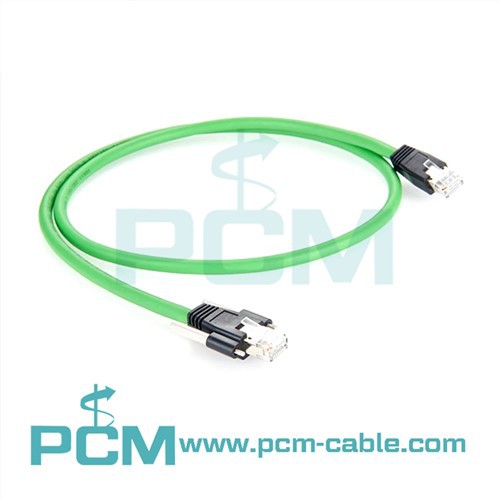
Hey there! As a GigE cable supplier, I often get asked about what cross-talk is in a GigE cable. So, I thought I'd take a moment to break it down for you in a way that's easy to understand.
What is Cross-Talk?
Cross-talk is basically the interference that occurs between different signal-carrying conductors within a cable. In a GigE cable, which is used for high-speed data transmission in Ethernet networks, cross-talk can be a real pain in the neck. It happens when the electrical signals in one conductor create an unwanted electromagnetic field that affects the signals in adjacent conductors.


Think of it like people talking in a crowded room. If one person is speaking really loudly, it can be hard for others to have a clear conversation. In the same way, when there's a lot of cross-talk in a GigE cable, the data signals can get jumbled up, leading to errors and slower transmission speeds.
Types of Cross-Talk
There are two main types of cross-talk that you need to know about: near-end cross-talk (NEXT) and far-end cross-talk (FEXT).
Near-End Cross-Talk (NEXT)
NEXT occurs at the same end of the cable where the signal is being transmitted. It's like when you're standing next to someone who's talking really loudly, and you can hear their conversation even though you're trying to focus on your own. In a GigE cable, NEXT can cause the receiving end to pick up unwanted signals from adjacent conductors, which can lead to data errors.
Far-End Cross-Talk (FEXT)
FEXT, on the other hand, happens at the opposite end of the cable from where the signal is being transmitted. It's like when you're in a different room from someone who's talking, but you can still hear a faint echo of their conversation. In a GigE cable, FEXT can also cause data errors, but it's usually less of a problem than NEXT because the signals have to travel a longer distance.
Why is Cross-Talk a Problem in GigE Cables?
GigE cables are designed to transmit data at very high speeds, typically up to 1 Gigabit per second. When there's a lot of cross-talk in the cable, it can interfere with the data signals and cause errors. These errors can lead to slower transmission speeds, dropped connections, and even system failures.
For example, let's say you're using a GigE cable to connect a high-resolution industrial camera to a computer. If there's a lot of cross-talk in the cable, the camera may not be able to transmit the data accurately, which can result in blurry or distorted images. This can be a big problem in industries where precision and reliability are crucial, such as manufacturing, robotics, and machine vision.
How to Reduce Cross-Talk in GigE Cables
There are several ways to reduce cross-talk in GigE cables. Here are some of the most effective methods:
Twisted Pairs
Most GigE cables use twisted pairs of conductors to reduce cross-talk. The twisting helps to cancel out the electromagnetic fields created by the signals in adjacent conductors, which reduces the interference. The more twists per unit length, the better the cable is at reducing cross-talk.
Shielding
Another way to reduce cross-talk is to use shielded cables. Shielded cables have a layer of conductive material, such as aluminum foil or braided copper, that surrounds the conductors. The shield helps to block the electromagnetic fields and reduce the interference. Shielded cables are more expensive than unshielded cables, but they offer better performance in environments with high levels of electromagnetic interference.
Proper Installation
Proper installation is also important for reducing cross-talk in GigE cables. Make sure the cables are installed correctly and that they are not bent or kinked. Avoid running the cables near sources of electromagnetic interference, such as power lines or motors.
Our GigE Cable Products
At our company, we offer a wide range of GigE cables that are designed to minimize cross-talk and provide reliable high-speed data transmission. Our cables are made with high-quality materials and are tested to meet the highest industry standards.
One of our popular products is the High Flex Cat6a GigE Ethernet Cable. This cable is designed for applications that require high flexibility and durability, such as industrial automation and robotics. It features a high-flex design that allows it to bend and twist without breaking, and it's shielded to reduce cross-talk and electromagnetic interference.
Another great product is the High Flex RJ45 GigE Cable with Horizontal Right Angle Down Angle and Thumbscrews. This cable is perfect for applications where space is limited, as it has a right-angle connector that allows it to be installed in tight spaces. It also features thumbscrews for secure connections, which helps to prevent the cable from coming loose.
Finally, we offer the Industrial Vision Camera GigE Cable with Screw Lock. This cable is designed specifically for industrial vision cameras, and it features a screw lock connector that provides a secure and reliable connection. It's also shielded to reduce cross-talk and electromagnetic interference, which helps to ensure accurate data transmission.
Contact Us for GigE Cable Solutions
If you're looking for high-quality GigE cables that are designed to minimize cross-talk and provide reliable high-speed data transmission, look no further. Our team of experts is here to help you find the right cable for your application. Whether you need a standard cable or a custom solution, we can provide you with the products and support you need.
So, don't hesitate to contact us today to learn more about our GigE cable products and how they can benefit your business. We look forward to hearing from you!
References
- "Ethernet Cabling: A Beginner's Guide." Network World.
- "Understanding Cross-Talk in Ethernet Cables." TechTarget.
- "Gigabit Ethernet: How It Works and Why It Matters." Cisco.