If you’ve ever worked with robotic systems—whether industrial arms, collaborative robots (cobots), or mobile robots navigating tight factory floors—you’ve probably run into a frustrating problem: standard straight cables sticking out of joints, sensors, or control modules can catch on equipment, get pinched during movement, or restrict the robot’s range of motion. That’s where angled cables come in, and as a supplier focused exclusively on angled connectivity solutions for robotics, I get asked this question all the time: Are there actually angled cables designed specifically for robotic systems?
The short answer is yes—but not all angled cables are created equal. For robotics, a one-size-fits-all angle cable from a general electronics supplier won’t cut it. Robotic environments demand cables that can withstand constant flex, extreme temperatures, vibration, and high mechanical stress, while also fitting into the compact, space-constrained designs of modern robots. Over the years, I’ve worked with robotics engineers integrating these cables into everything from assembly line cobots to autonomous guided vehicles (AGVs), and the impact on performance and durability is undeniable.
Why Robotic Systems Need Angled Cables in the First Place
To understand the need, let’s break down the unique challenges of robotic cable management. Industrial and collaborative robots have joints (axes) that rotate 180 degrees or more during operation—think of a robot arm twisting to assemble a car door, or a mobile robot navigating a narrow aisle with its sensor array pointed at the floor. Straight cables mounted to these moving parts create two big issues:
- Pinch Points and Interference: In tight spaces (like between a robot arm and its base, or inside a cobot’s compact control enclosure), a straight cable can get crushed between moving components, leading to fraying, broken conductors, or complete failure. Even if it doesn’t pinch, a straight cable sticking out at a right angle can catch on nearby tools, conveyor belts, or other robots, causing costly downtime.
- Flex Fatigue: Robots operate on cycles—thousands of repetitive moves per hour. A straight cable bending sharply at the connector (the typical installation for straight cables) will develop micro-cracks in the conductor insulation over time. Angled cables, by design, distribute that flex stress evenly along the cable’s strain relief, drastically extending its lifespan in high-cycle applications.
That’s not to say angled cables are a new invention—they’ve been used in consumer electronics, gaming, and audio for decades. But for robotics, the bar is much higher. Robotics cables need to be flexible, shielded to reduce electromagnetic interference (EMI) from nearby machinery, and rated for industrial environments (IP67 or higher for dust and water resistance, in many cases).
The Angled Cables We’ve Developed for Robotic Applications
At our company, we specialize in angled cables tailored to robotic and industrial use cases. Let’s look at some of the products engineers reach for most, and how they solve specific pain points:
-
Low Profile HD15 Female to Male 90 Degree Angled VGA Cable
Many older and mid-tier robots still use VGA connections for their vision sensors, end-of-arm tooling (EOAT), or internal display ports. But in compact robotic arms, the standard VGA connector is often too bulky, and a straight cable will stick out awkwardly. Our Low Profile HD15 VGA cable has slim 90-degree angled connectors that fit into tight sensor enclosures without adding extra height. It’s also built with a PVC jacket rated for repeated flex, making it ideal for EOAT connections that move with the robot’s gripper. You can learn more about this cable here: Low Profile HD15 Female to Male 90 Degree Angled VGA Cable -
DIN 5 Pin Straight to Right Angle MIDI Cable
Robotic systems that integrate with external control systems, musical machinery (like custom assembly line testing tools), or legacy robotic controllers often use DIN 5 pin MIDI connections. These straight cables can kink or pull loose when mounted on moving parts. Our DIN 5 Pin cable has a straight connector on one end for fixed control modules and a right-angle angled connector on the other, designed to sit flush against the robot’s joint without interfering with rotation. The cable is shielded to block EMI from motors and power lines, which is critical for reliable signal transmission in noisy factory floors. For details: DIN 5 Pin Straight to Right Angle MIDI Cable -
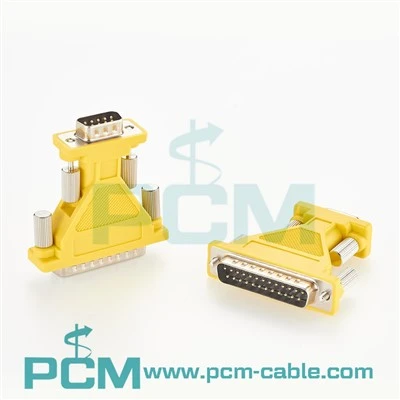
DB25 DB44 HD44 Right Angle Connector
For heavy-duty robotic applications—like industrial welding arms, which use high-speed data connections between the arm’s controller and welding torch—DB connectors are common. Straight DB cables have large, rigid connectors that can’t angle away from tight mounting points. Our DB25, DB44, and HD44 right angle connectors are molded with reinforced strain reliefs to handle the torque and vibration of industrial welding and assembly. They’re also compact enough to fit into the small access ports on most industrial robot arms. Check them out here: DB25 DB44 HD44 Right Angle Connector -
Low Profile RS232 DB9 Cable Profile Connectors M/F
RS232 is still used for many legacy robotic communication interfaces, from cobot teach pendants to old control modules. The problem with standard straight DB9 cables is that they’re too thick and rigid for mobile robots, which often have their communication ports mounted on the side or bottom. Our Low Profile RS232 DB9 cable has slim, low-profile right angle connectors that fit into the compact ports on mobile robots and cobot enclosures. It’s built with a flexible TPE jacket that can withstand thousands of flex cycles, making it perfect for teach pendants that are moved multiple times a day. Learn more: Low Profile RS232 DB9 Cable Profile Connectors M/F

-
Flat 5-Pin DIN MIDI Patch Cable
For modular robotic systems that use daisy-chained connections between modules (like collaborative robot arms with multiple EOAT tools), space is at a premium. Round DIN cables take up extra space and can tangle with other cables, but our Flat 5-Pin DIN MIDI Patch Cable is low-profile, flat, and flexible, designed to route neatly between robot modules without catching on moving parts. The right-angle connectors let you mount the cable flush against the robot’s frame, reducing profile height and eliminating interference. For details: Flat 5-Pin DIN MIDI Patch Cable
Real-World Impact in Robotic Integration
Last year, I worked with a team at a large automotive assembly plant that was dealing with a persistent issue: their line of 12 cobots had a 15% cable failure rate, caused by straight VGA cables catching on the robot’s end-of-arm gripper during door panel assembly. The downtime was costing them nearly $50,000 a month in lost production. We worked with their engineering team to swap out the straight VGA cables for our Low Profile HD15 Angled VGA Cables. Within three months, their cable failure rate dropped to less than 1%, and their production uptime increased by 12%. That’s the kind of result angled cables deliver when they’re designed for robotics, not just general use.
Another example: a startup building small mobile delivery robots was struggling with their AGVs’ communication cables. The straight RS232 cables they were using kept pinching between the robot’s body and wheel assembly during turns. We recommended our Low Profile RS232 DB9 Cable, with right-angle connectors that mount flush to the robot’s side. The AGVs now run 24/7 with no cable-related interruptions.
Choosing the Right Angled Cable for Your Robotic System
It’s important to note that not all angled cables work for every robotic application. When selecting a cable, here are three key factors to keep in mind:
- Connector Type: Match the angled connector to your robot’s interface (VGA, DIN, DB, etc.)—we offer right-angle and low-profile variants for the most common robotic connections.
- Flex and Durability: Look for cables rated for “industrial flex” (usually 10,000+ cycles) and with reinforced strain reliefs, which prevent conductor breakage at the connector.
- Environmental Rating: For robots used in outdoor or harsh factory environments, choose cables with IP65 or higher resistance to dust and moisture.
If you’re not sure which angled cable is right for your specific robot setup, our team works directly with engineers to customize solutions—whether you need a standard right-angle cable or a custom length for a unique mounting space.
Let’s Talk About Your Robotic Cable Needs
Cable-related downtime is one of the most avoidable costs in robotic systems. If you’re experiencing issues with straight cables catching, pinching, or failing too soon, angled cables are a proven solution. We’ve worked with small cobot startups and global industrial automation firms to deliver angled cables tailored to their exact needs.
To discuss your robotic integration project, reach out to our team to explore custom or standard angled cable options that fit your application’s requirements.
References
- Robotics Industry Association. (2022). Industrial Robotic Cable Management Best Practices. RIA Standards Publication.
- Flex, Inc. (2021). Flex Fatigue in Industrial Cables: A Testing Analysis. Advanced Materials & Processes Journal.
- International Electrotechnical Commission (IEC). (2020). IP Rating Standards for Robotic Components. IEC 60529.
- Collaborative Robot Association. (2023). Cable Integration for Cobot Joints. Robotic Systems Design Quarterly.